 Wakey
Wakey
Explainer
How to Wake Up Early Consistently (Without Relying on Willpower)
Motivation at 6 AM is unreliable. Decide the night before, protect your bedtime, and keep a scoreboard with only two results.

If you want to know how to wake up early consistently, stop relying on how you’ll feel when the alarm goes off. Pick one wake time and keep it every day. Work backwards to a bedtime that protects your sleep. Lock the decision in the night before, so half-asleep you can’t renegotiate it. Then score each morning as a plain win or loss, with rest days planned ahead. One missed morning won’t undo the habit; quitting after it will. The 7-day plan is at the end.
Evening-you vs morning-you: why early mornings fall apart
Every early-morning plan has two authors. Evening-you is rested and ambitious: of course you’ll be up at 6 and out for a walk before work. Morning-you is warm, groggy and very persuasive. When the alarm rings, morning-you gets a vote, and it always votes for ten more minutes.
That isn’t a character flaw; it’s a timing problem. Most advice tries to make morning-you tougher with more motivation or a louder alarm, which asks the weaker negotiator to win. It works better to settle things before morning-you shows up. For the in-the-moment side, see how to stop hitting snooze.
Commitment devices: decide before you’re tired
Economists call these arrangements commitment devices: choices that tie your own hands in advance. In a review of the evidence in the Annual Review of Economics, Bryan, Karlan and Nelson (2010) separate hard commitments, which carry real economic penalties, from soft ones, where the cost is mainly psychological. Mornings suit both: you choose in the evening and get tempted at dawn.
| Commitment | Set when | What it takes away |
|---|---|---|
| Wake time and first task written down | Evening | “I’ll see how I feel” |
| Phone charging across the room | Evening | Stopping the alarm without standing up |
| An alarm that only stops after a task | When you set it | Drifting back to sleep on autopilot |
| A goal you can’t edit in the last few hours | Hours ahead | Moving the goalpost at 3 AM |

Work backwards from wake time to bedtime
An earlier alarm without an earlier bedtime isn’t a routine. It’s sleep debt on a schedule. Do the math in reverse:
- Fix the wake time. Choose one you can keep every day. The CDC lists going to bed and getting up at the same time every day among its basic sleep habits.
- Subtract your sleep. The CDC’s general guidance for adults aged 18 to 60 is 7 or more hours a night. Add the time you usually take to fall asleep.
- Subtract your wind-down. If your routine takes 30 minutes, start it 30 minutes before lights out.
Example: up at 6:00 with 8 hours in bed means lights out at 10:00 and wind-down from 9:30. That 9:30 is where your morning really starts.
These are general figures, not a prescription. And if your target is far from your current wake time, don’t jump: the Sleep Foundation suggests moving bedtime and alarm earlier in 15-minute steps, with at least a few days between shifts.
Make it binary: a win or a loss
“Get up earlier” stretches to cover 7:40 on a bad day. “Out of bed by 6:30” doesn’t. Draw one line and give each morning exactly two outcomes: before the line is a win, after it is a loss. No partial credit for being awake but still in bed.
Binary scoring ends the debate about whether today “counts”. After two weeks it also shows patterns, like Mondays failing after late Sundays, that a vague sense of doing OK would hide. Score each day once, then leave it.
Streaks, losses and rest days
A run of wins becomes a streak, and streaks change the stakes. On day one, sleeping in costs one morning. On day twelve, it costs twelve.
In a 2023 paper in the Journal of Consumer Research, Silverman and Barasch found that people whose logs showed an intact streak were more likely to keep going than people whose logs showed a broken one, even when their actual past behavior was the same. Keeping the streak became a goal in itself. A break hit harder when people blamed themselves, and less hard when they could repair the streak.
A streak can pull you out of bed; a broken one can make you quit. Two habits keep the upside:
- Plan rest days in advance. Decide on Sunday which mornings are off. They don’t add to the streak or break it.
- Build in slack. Sharif and Shu found that framing a goal with “emergency reserves” (say, 7 days a week plus 2 emergency skip days) helped people persist after a failure, compared with equivalent goals without slack. With a reserve, people still felt they were making progress when they slipped.
What to do after a miss
You will miss mornings: a cold, a late flight, a bad night. What matters is the next one.
Habit research is reassuring here. Lally and colleagues followed 96 volunteers building a daily habit for 12 weeks. How long it took people to get close to their peak automaticity ranged from 18 to 254 days, and missing one opportunity did not materially affect the process. The damage comes from treating one miss as proof you’ve failed.
- Score it honestly as a loss. A fudged line teaches you the line is negotiable.
- Find the cause: a late bedtime, the phone in bed, or a jump that was too big.
- Fix one thing tonight, keep the same wake time tomorrow, and skip the punishing earlier alarm.
When it’s more than habitIf you can’t wake up despite plenty of time in bed, or feel exhausted however much you sleep, talk to a doctor or another qualified clinician.
How Wakey builds these ideas in
We built Wakey around these ideas. It’s coming soon to iPhone and Android, and isn’t in the stores yet. What it does:
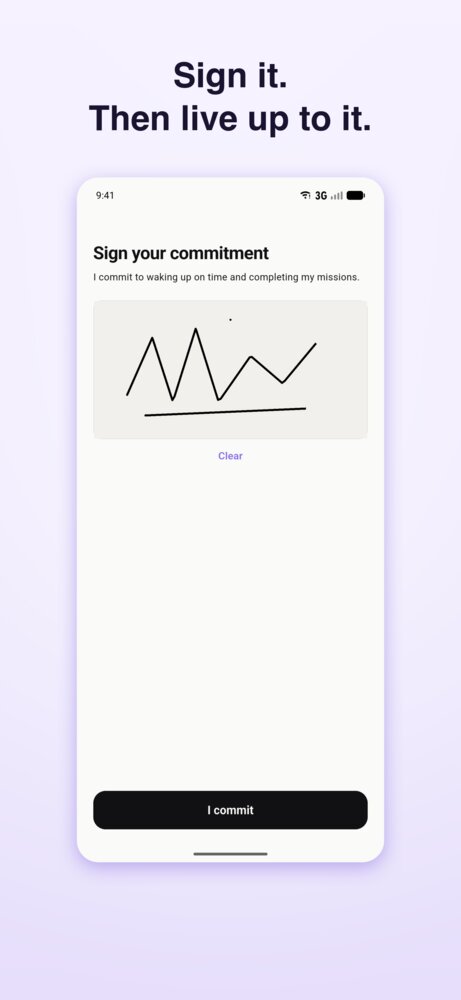
- A signed commitment. During onboarding you draw your signature under “I commit to waking up on time and completing my missions.” The image never leaves your phone.
- A goal that locks. Within 4 hours of an alarm, the editor won’t let you change its time or repeat days, and it tells you why: “No moving the goalpost.” At 11 PM you can still move a 6:30 alarm; from 2:30 AM, you can’t.
- No snooze. The alarm rings until you finish a mission, such as math problems, 10 push-ups counted by the camera, or an affirmation read aloud. After 3 failed attempts it switches to math, so you’re never stuck.
- A two-result scoreboard. Finish the alarm’s mission within 30 minutes of the alarm time, or tap Log Wake Up before it, and the day is a win; miss that and it’s a loss. Days with no alarm are neutral rest days.
- Bedtime math. The home screen shows “Go to bed by”, 8 hours before your alarm.
- Streaks and badges. Progress shows your current and best streak, a list of past days, and nine badges from Early Riser (1 day) to Centurion (100 days).
One honest gap: Wakey has no streak repair or skip days. A loss resets your current streak (your best stays on record), so your slack comes from leaving planned rest days without an alarm.
How to wake up early consistently: a 7-day starter plan
The goal this week is a routine you can repeat, not your final wake time.
- Day 1. Pick your target wake time, but set tomorrow’s alarm only 15 minutes earlier than usual. Write down the time and your first task.
- Day 2. Do the bedtime math and set a reminder for when wind-down starts. Move the phone charger out of reach of the bed.
- Day 3. Start the scoreboard: a win or a loss, marked once, no debate.
- Day 4. Choose this week’s rest day, if any, and mark it now.
- Day 5. Give the morning a reason: coffee by the window or a short walk outside. The Sleep Foundation calls bright morning light one of the best ways to become more of a morning person.
- Day 6. Review the tally. For each loss, name the cause and fix one thing.
- Day 7. Mostly wins? Hold the time a few more days, then move it another 15 minutes. Mostly losses? Keep the time and fix the bedtime first.

Comparing apps? See our guide to alarm apps for heavy sleepers, including where Wakey falls short.
Frequently asked questions
How long does it take to get used to waking up early?
It varies a lot. In Lally and colleagues’ habit study, a daily behavior took anywhere from 18 to 254 days to become close to fully automatic. Moving in 15-minute steps, a 90-minute shift alone takes a few weeks.
Should I wake up at the same time on weekends?
The CDC’s general advice is to get up at the same time every day. If you want a later morning, plan it in advance and keep the difference small.
What is a commitment device?
A choice you make in advance that limits what a less motivated future you can do, such as charging your phone across the room. Economists separate hard commitments, with real economic penalties, from soft ones, where the cost is mostly psychological.
How do I become a morning person?
Shift your bedtime and wake time earlier in small steps (the Sleep Foundation suggests 15 minutes, a few days apart), keep the wake time steady, and get bright light early in the day. If you can’t fall asleep earlier or feel exhausted however long you sleep, talk to a qualified clinician.
Wakey is an accountability and habit tool, not a medical device. If you have a sleep disorder or persistent sleep problems, talk to a qualified clinician.